Metricentric / Biomedical Division

Biomedical
Engineering.

Technologies for rehabilitation and movement assistance: from human–device interaction to biomechanical models and robotic systems integrated with ROS and AI.

Assistive roboticsROS / ROS 2Artificial IntelligenceDigital TwinBiomechanics
Illustration of a patient wearing a robotic device while standing up, assisted by two healthcare workers
ROBOT-ASSISTED REHABILITATION Concept illustration · synthetic people
Spotlight / Calabria R&D project

Research and innovation
for new biomedical technologies.

Metricentric presents its research path linked to the regional initiative supporting research, development and innovation under the Calabria ERDF–ESF+ 2021–2027 Programme, Action 1.1.1.

This research runs alongside the development of Rehab Twin and the other technology streams of the Biomedical division.

Open the project page ↗
Metricentric / Research & Innovation

Biomedical Engineering
Research Initiative

Applied research, robotics and intelligent systems for biomedical technologies.

CALABRIA REGION · ERDF–ESF+ 2021–2027
ACTION 1.1.1 · RESEARCH, DEVELOPMENT AND INNOVATION

Participation in the public call — no statement that funding has been granted.

Biomedical / Research and development

Real movement.
Its digital twin.

Metricentric's biomedical research connects rehabilitation scenarios, musculoskeletal models, data acquisition and assistive robotics. It is an ongoing line of work for the company, independent of any participation in regional funding calls.

Biomedical / Signals and software

Holter ECG analysis.
24 hours of heartbeats, read one by one.

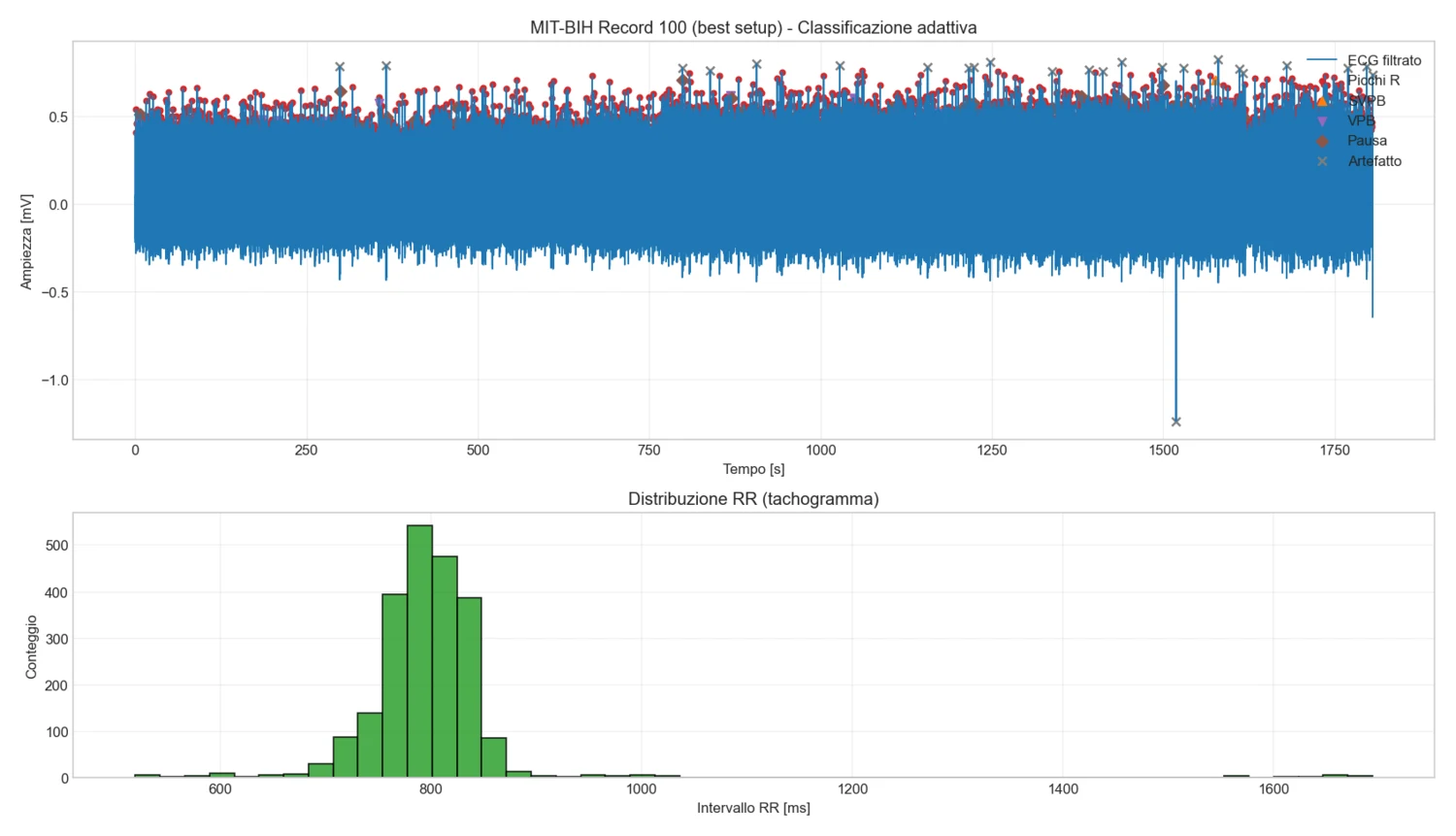
A Holter recording contains more than a hundred thousand heartbeats. Metricentric is developing research software that reads long-term multichannel ECG recordings and extracts beats, rhythm, pauses, atrial fibrillation, ST segment and QT interval, to help the reader go straight to the episodes worth reviewing.

30-minute ECG trace with classified beats and a histogram of the RR-interval distribution
MIT-BIH reference record 100: beats detected and classified along the trace (top) and distribution of RR intervals (bottom) · data from the public PhysioNet database
Multichannel HolterLong-term ECG recordings, including EDF format
Rhythm · Pauses · AF · ST · QTAnalysis modules developed and measured separately
Pre-registered testsCriteria set before looking at results, checks on held-out data
  • Beat detection and morphological classification
  • Search for pauses and asystole across the whole recording
  • Atrial fibrillation windows and burden estimation
  • ST segment and QT / QTc interval measurements
  • Systematic comparison with annotated reference ECG databases
  • Software life cycle structured on IEC 62304, ISO 14971 and IEC 62366-1

Software at the research and development stage: it is not a CE-marked medical device and is not available for clinical use. The figures show data from public databases, not patients followed by Metricentric.

Technology pillars

A research ecosystem
for human movement.

Development areas presented as technology and design streams, not as certified clinical products.

01 / BIOMECHANICS

Biomechanical modelling

Musculoskeletal models and simulations for studying the kinematics and function of the upper limb and hand.

02 / DIGITAL TWIN

Digital twin

Architectures that bring together data, biomechanical simulations and digital representations of devices and users.

03 / ROBOTICS

ROS & assistive robotics

Development of ROS-based robotic pipelines and interfaces for simulation, control and hardware integration.

04 / INTELLIGENCE

AI & data-driven systems

Exploring data-processing and artificial-intelligence algorithms to support analysis and system adaptation.

05 / WEARABLE

Exoskeletons and assistive devices

Research and cooperation in developing wearable devices that support motor activities.

06 / VALIDATION

Prototyping and validation

Iterative modelling, integration and preliminary verification in a simulated environment.

07 / SIGNALS

Biomedical signals

Processing of long-term ECG signals: filtering, beat detection, interval measurement and arrhythmia recognition.

08 / QUALITY

Software for healthcare

Documented development with risk management, requirements traceability and repeatable tests, as a basis for a future regulatory pathway.

Research focus

From the digital model
to the robotic system.

The research goal is to connect biomechanical models, sensors, software and robotic devices into a coherent workflow that can be verified and progressively validated.

Biomechanical model → Data acquisition → Digital twin → ROS integration → Robot / device

These are research streams and goals, not established clinical results or devices approved for medical use.

R&D architecture / concept
Biomechanics & simulation

Representing and studying human movement.

Digital intelligence

Data integration, AI and simulation.

Robotics & interaction

Communication and control through ROS.